Watch the ripples,
not the speedometer
Recoverable Self-Coding: seeing the unrecoverable coming — while you can still change course.
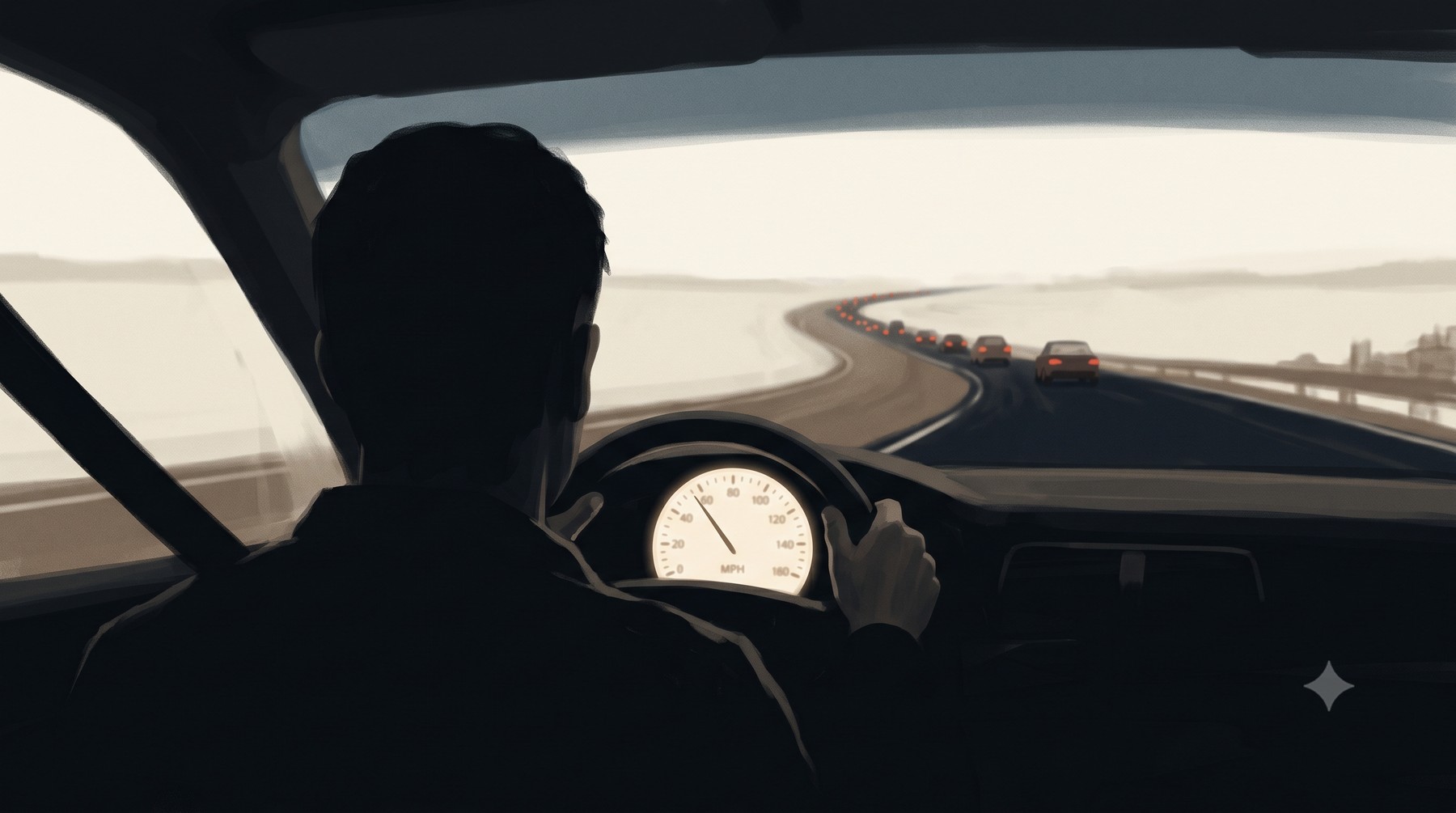
We watch the outcome —
and the outcome is too late
prompts/s2_dashboard.txt
Fast systems — and AI most of all — force more and more irreversible decisions.
But we judge our decisions by the end result: the macrostate. By the time they look wrong, the decision is already made. You can't un-decide it.
Cars are decisions. The road is your capacity.
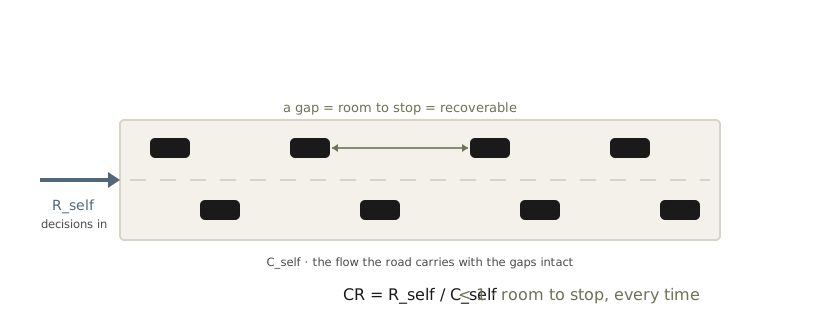
Decisions flow in at rate R_self; the road carries C_self of them with the gaps intact; their ratio is CR = R_self/C_self. Below capacity every car keeps a gap — room to stop, so the move is recoverable.
Past capacity: still moving, but no room to stop
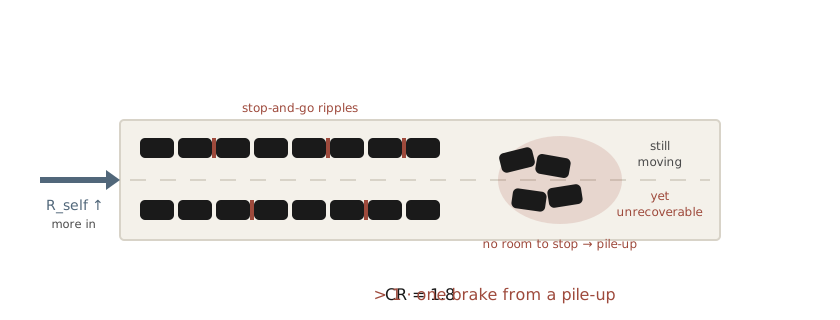
As CR → 1 the gaps vanish. Traffic still flows — still gets where it's going — but bumper-to-bumper there's no room to stop: one brake ahead and it's a pile-up. Still moving, yet unrecoverable — that's the decoupling.
Read the ripples — act before the jam

Two lanes, same rising demand. Watch only the outcome (top lane) and you pile into the jam. Read the ripples — their spread $\sim(1-\mathrm{CR})^{-2}$ trips the alarm first — and act in the lead time (lower lane): the gaps stay small, but you hold below capacity. Ignore the alarm and the dashed line lands you in the same jam.
Speedometer → the pile-up.
Ripples → time to act.

prompts/s6_pileup.txt
Wait for the speed to collapse and you're already in the pile-up — one you can't undo.
The ripples gave you a lead time: the window to certify — check you've still got room to stop — before you act.
One map for every word
| Cars flowing in | → | induced flux R_self |
| What the road can carry | → | capacity C_self |
| Flow ÷ capacity | → | CR (→ 1 at the edge) |
| A check you've room to stop | → | certify a decision |
| You can still brake | → | recoverable |
| The ten-car pile-up | → | unrecoverable / irreversible |
| Stop-and-go ripples | → | microstate fluctuations |
| Average speed / the jam | → | macrostate (the outcome) |
| Gap before the jam | → | the lead time |
Three moves — taken in the lead time
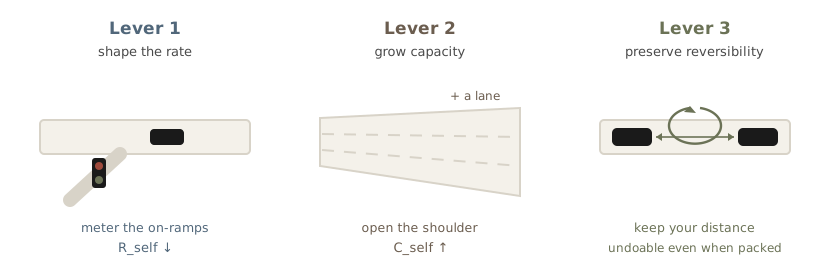
Shape the rate · grow the capacity · or preserve reversibility — keep every decision undoable, even bumper-to-bumper.
Same packed road. Opposite outcome.
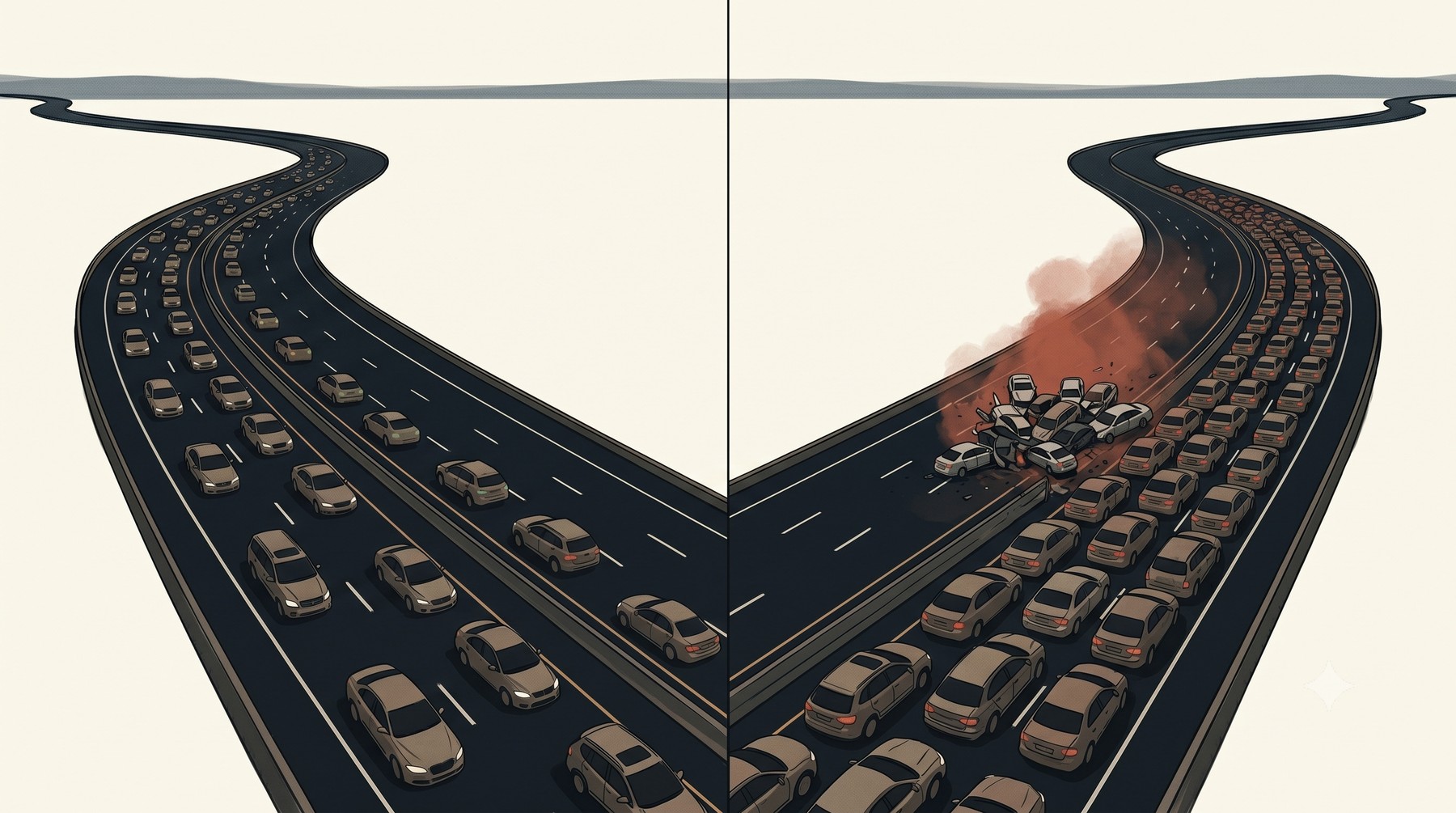
prompts/s9_gap_vs_tailgate.txt
Bumper-to-bumper either way (CR = 1.8). A gap is a safe stop; no gap is a pile-up. Lever 3 kept the ability to undo.
An instrument that reads the ripples
from counts you already have
Read the ripples · certify before you act · preserve reversibility while you still can.
Watch the ripples, not the speedometer.