About
Pieter van Rooyen — the visual thug and the intellectual snob behind Raconteur Road. The road came a long way before the résumé.
I have never been very good at staying in one lane for too long. This has been useful professionally, though occasionally inconvenient in polite company. I have spent much of my life moving between worlds that are not supposed to speak to each other: electronics and biology, biology and data, data and decisions, ideas and companies, companies and the stubborn machinery of real life. I have founded technology companies, written scientific papers, taught engineering, filed patents, built teams, raised money, and chased more than a few impossible ideas until they either became useful or taught me why they would not.
But Raconteur Road did not begin in a boardroom, a laboratory, or a patent office. It began on the road — in dust clouds, bad maps, border crossings, cheap coffee, broken tracks, long horizons, and the dangerous pleasure of going, not always to arrive, but to see what happens when the map thins out and the world starts speaking for itself.
Raconteur Road is the book. This website is its companion: a place for the photographs, field notes, scientific digressions, half-serious theories, and aftershocks that gathered around the fire afterward.
I suppose I am, by temperament, a visual thug and an intellectual snob — both meant with caution and a little evidence. The visual thug wants the photograph first: the dust, the light, the face, the road, the animal, the horizon, the odd thing seen badly but felt correctly. He trusts instinct, movement, weather, timing, and the blessed accident of being there. The intellectual snob arrives later, annoying everyone, asking what it means. He wants the physics, the information theory, the entropy, the hidden structure, the reason the dust cloud never forms the same way twice.
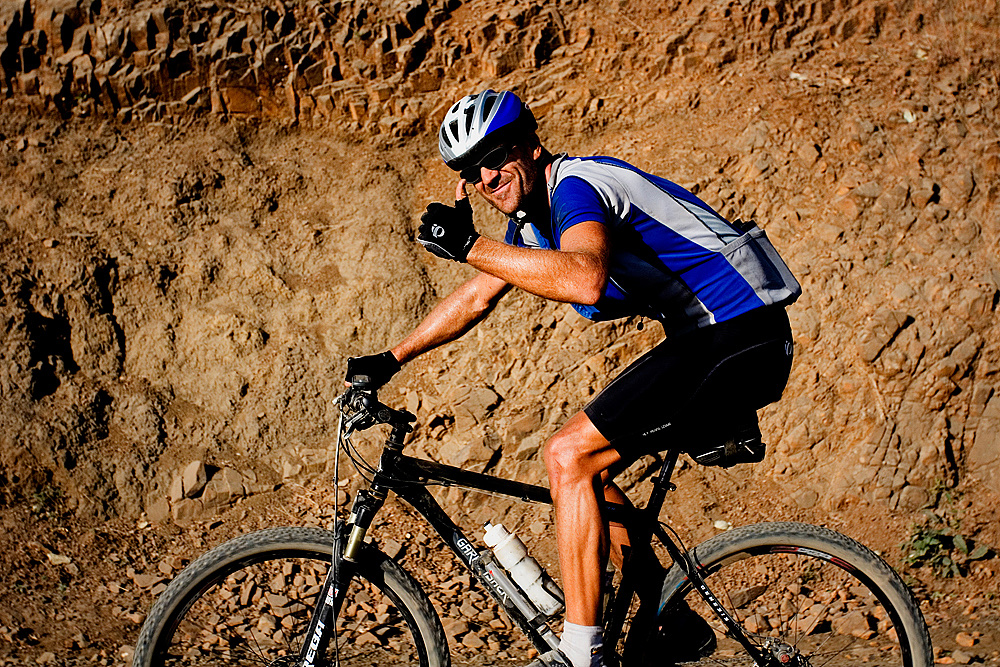
Between the two of them, a life has taken shape. Cycling has been one long version of the same argument. Over the last twenty years I have recorded more than 200,000 kilometers on a bicycle, mostly a record of voluntary suffering, early mornings, bad decisions, good legs, bad legs, weather, mountains, and the quiet discovery that motion edits the mind. Paragliding, diving, overlanding, photography — they are all variations on the same instinct. Leave the surface. Leave the road. Leave the known explanation. Go and see what else the world is doing.
I have always liked edges: the edge of a continent, the edge of a theory, the edge of a salt pan, the edge of a technology just before it becomes obvious. Where the machine meets biology, light becomes data, a photograph becomes memory, a road becomes a story, and a story starts demanding equations.
That is where the science enters.
Underneath the résumé language — founder, CEO, professor, patents, papers, companies, technologies — the obsession has always been simpler and stranger: how does the world encode itself, and how much of that encoding can a person, a machine, or a society absorb before it begins to lose itself?
The book is not a résumé, not a travel guide, not quite a photography book, and not quite a science book either. It is a record of being processed by the world.
The visual thug went looking for light. The intellectual snob went looking for meaning. The road, as usual, had other plans.