The scientific underpinning of Raconteur Road. Recoverable Self-Coding (RSC), the annealing schedule, finite capacity. The book is the photographic companion to these papers — the road is the framework lived.
Flies. I noticed them somewhere out on the Makgadikgadi salt pans, after the road had stopped pretending to be a road and become a pale rumour across the white earth. They had entered the cab without invitation and settled in as if they had ordered an Uber to drive them across the white desolation. One sat on the windscreen, cleaning, I suppose, its impossible little hands. The other circled my head with the confidence of something that had never once needed a map.
"You two," I grumbled, "have no idea where you are." They ignored me, which was probably wise.
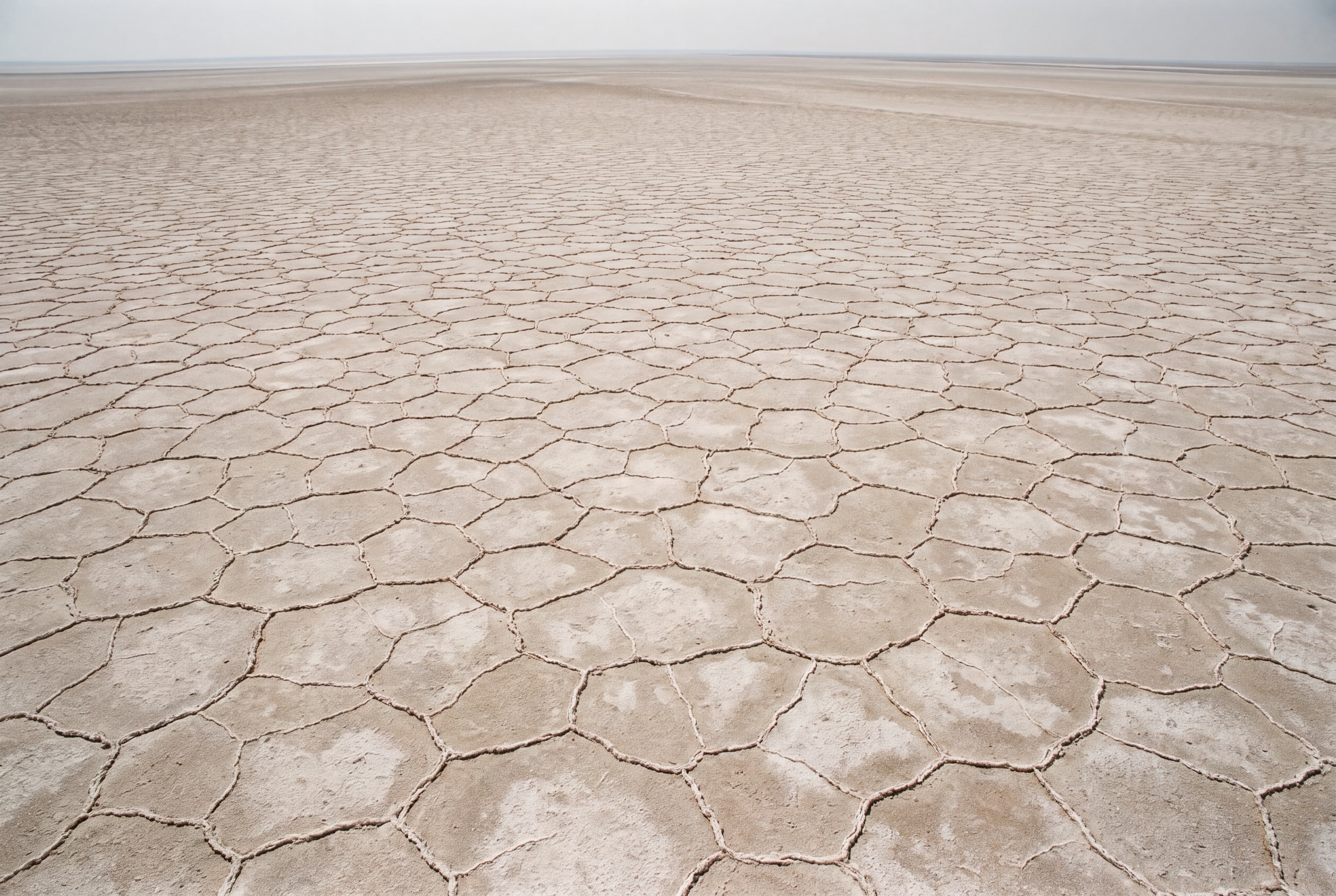
Outside, the Makgadikgadi stretched away in every direction, flat and white and impossibly old. It looked like the end of something. The end of water. The end of roads. The end of movement itself. A vanished lake lying in the middle of Botswana, dried into salt and silence, with Kubu Island somewhere ahead, its baobabs waiting like old witnesses on a granite outcrop.
The Makgadikgadi — a vanished lake, dried to salt and silence.
But that is the trick of the place. The Makgadikgadi looked like the end of motion, but it was where I first began to see motion everywhere. The flies knew this before I did. A fly does not believe in emptiness. A crack in the salt is a canyon. A smear on the glass is a map. A drop of sweat is a waterhole. Where I saw a dead lake, they saw a busy world. Where I saw silence, they saw opportunity.
Perhaps that is what the road has always done for me. Raconteur Road was never only a road. It was the road of stories, the road that spoke in dust clouds, wrong turns, broken tracks, chance meetings, old maps, bad coffee, good light, and the strange feeling that beyond every horizon there was another horizon waiting to explain the first one. You think you are travelling through a place, but the place is also travelling through you.
Behind us, the dust rose into the mirror. It was white here, almost ghostly, not like the red dust of the Kalahari or the gold dust that follows you at sundown on other African roads. It lifted from the pan, folded, loosened, gathered itself, and then vanished into the air. A few minutes later another cloud rose behind the vehicle, made from the same salt, the same tires, the same wind, the same turning wheels. But it was not the same cloud.
"That," I said to the flies, "is the important part. The world never tells the same story twice." They did not seem to care about my insight.
The road may look the same. The vehicle may be the same. The wind may come from the same direction. But the dust does not rise in the same pattern, and it does not settle back into the same arrangement. The cracks in the salt do not write the same sentence twice. The flies do not fly the same mad circle around my head. Even silence, if you watch it long enough, is busy changing its mind.
For years I called that the wind. Later, I learned the better word.
Entropy.
Entropy sounds like something that belongs in a laboratory or a physics book, but out here on the Makgadikgadi it was not abstract at all. It was in the dust changing shape behind me. It was in the old lake that had become salt. It was in the heat lifting off the pan, in the road dissolving into tracks, in the baobabs waiting ahead, and in the two flies demonstrating, with irritating precision, that motion does not require permission.
The strange thing is that every dust cloud was also a kind of information. A brief record of speed, weight, wind, heat, surface, tire pressure, and time. Nature was generating patterns faster than I could name them, and inside the vehicle their little silicon hearts were beating fast, trying to keep up: the GPS calculating, the camera waiting, the phone storing, the dashboard blinking its quiet reports.
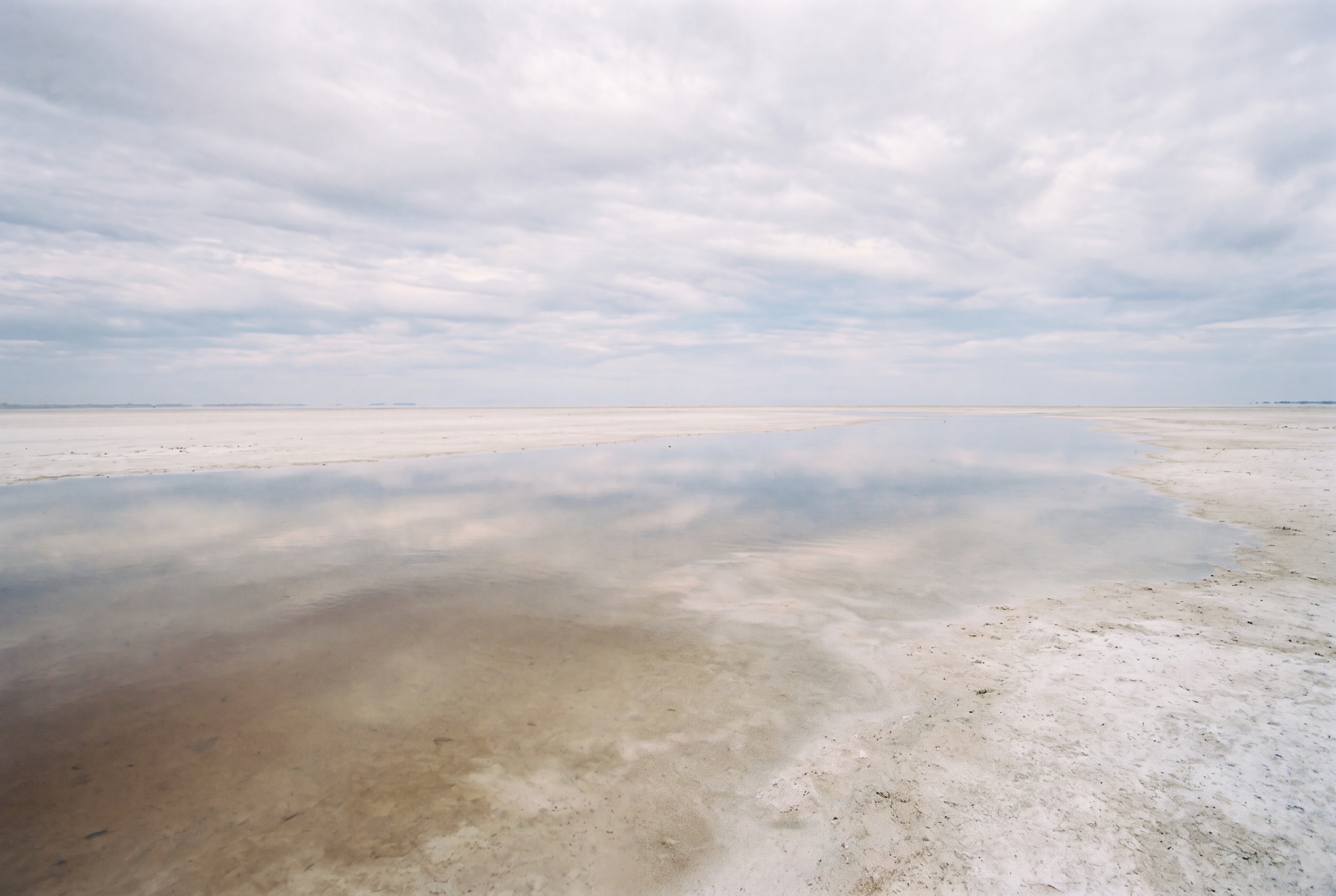
When the rains return, the dead lake floods and moves again — the same pan, generating flux.
We like to think we invented information because we learned how to trap it in machines. But the dust had been doing it long before us. So had salt pans. So had flies.
And that is where the road hands the story to the science — and the truth is that science is stranger and more fascinating than any story you invent.
Recoverable Self-Coding (RSC) begins with the same problem the dust cloud had already shown me in the mirror: the world produces flux, and every living thing, machine, institution, and traveler has only so much capacity with which to absorb it. Too little information and nothing can be understood. Too much, arriving too fast, and a system may still appear to function while quietly losing the ability to recover. RSC asks where that boundary lies — where motion becomes overload, where signal becomes burden, where a self can still decode the world without being undone by it.
So the road was never only a road, and the dust was never only dust. Makgadikgadi is a field lesson in entropy, information, and capacity. The pan generates the flux. The vehicle tries to process it. The flies adapted without complaint. I, being human, turned it into a story first and a theory later.
At Kubu Island, I stopped beneath the baobabs and opened the door. The flies left without thanking me. One vanished into the white glare. The other circled one last time around my head, as if to say the experiment was complete, and then followed. I watched them go with the mild resentment one feels toward passengers who contribute nothing to fuel, navigation, or conversation, yet somehow arrive exactly where they need to be.
For a while I stayed there among the rocks and baobabs, looking out over the salt. Then the light began to lean, and the day reminded me that all field lessons eventually become logistics. There was still distance to cover, still dust to make, still another road pretending it knew where it was going. So I closed the door, left Kubu behind, and drove on toward Gweta.
By the time I arrived, the pan had become road again, the white glare had softened into shopfronts and shade, and the silence had given way to the small commerce of a dusty village. There, beside a shop, I saw two flies rubbing their little hands together like old men after a successful business deal. I could not prove they were my passengers, but I had my suspicions.
And the irony was clear — I crossed the Makgadikgadi thinking about entropy, information, silicon hearts, flux and capacity. I turned the dust into a lesson and the road into a theory. The flies, meanwhile, needed none of it. They had ridden the flux, used my vehicle as capacity, exited at the right moment, and found the next opportunity before I had even finished naming the first one.
That, perhaps, was the lesson. Never look back for too long. Never wait for the dust to explain itself. When the door opens, move. A river that stops moving is no longer a river. It becomes salt.
The flies knew this. The road does not belong to those who understand it. It belongs to those who keep going.
a star→a chip→a cell→a self
The same decoder, four scales.
Preprint
Submitted to Entropy (MDPI)
·
2026
Adaptive Agency Under Accelerating Gradients
The foundational treatment: the rate–capacity law for recoverable action, and the cooling schedule that holds a system below capacity.
The program's foundational paper. Recoverable Self-Coding (RSC) treats the self as an adaptive decoder under finite Shannon throughput and recasts recoverability as a rate–capacity law: agency persists only while the induced flux stays below integrative capacity, and as accelerating gradients drive that ratio toward one, a system stays accurate while it loses the ability to recover. The cooling (annealing) schedule is the dynamics that hold it below capacity; the framework underlies the Raconteur Road book and the Pan-American expedition's geography as a literal cooling schedule.
Entropy, Capacity, and the Continuity of Agency in Human–AI Systems: A Recoverable Self-Coding Account
Presented at Entropy 2026 — the annual gathering on entropy and information-theoretic methods. The written proceedings, the poster, and the talk:
Recoverable Self-Coding (RSC) recasts the recoverability of irreversible action as a Shannon-style rate–capacity law: a self-decoder holds its induced flux below an integrative capacity, and as AI drives that ratio toward one, systems stay accurate while quietly losing the ability to recover — oversight becomes formal rather than substantive. The work supplies the missing order parameter, a universal boundary law for the loss of recoverability, and an early warning that fires before the irreversible crossing, read from counts a system already emits.
First-Order Recoverability Collapse in Self-Referential Information Decoders
The substrate paper: the statistical mechanics beneath the rate–capacity law — where, and how sharply, recoverability fails.
Treats a self-referential decoder as a dissipative system and shows that the loss of recoverability is a first-order transition: as the drive crosses threshold the recoverable state collapses discontinuously (a fold/cusp), with hysteresis — easing off does not undo the damage — and is cured only by a reset, an anneal. Avalanches on the boundary scale as s−3/2. This is the physical mechanism beneath RSC's rate–capacity boundary, derived in the closed loop.